
Day 1 - There Are No Bad Trips, Only Bad Attitudes
Well, That Happens
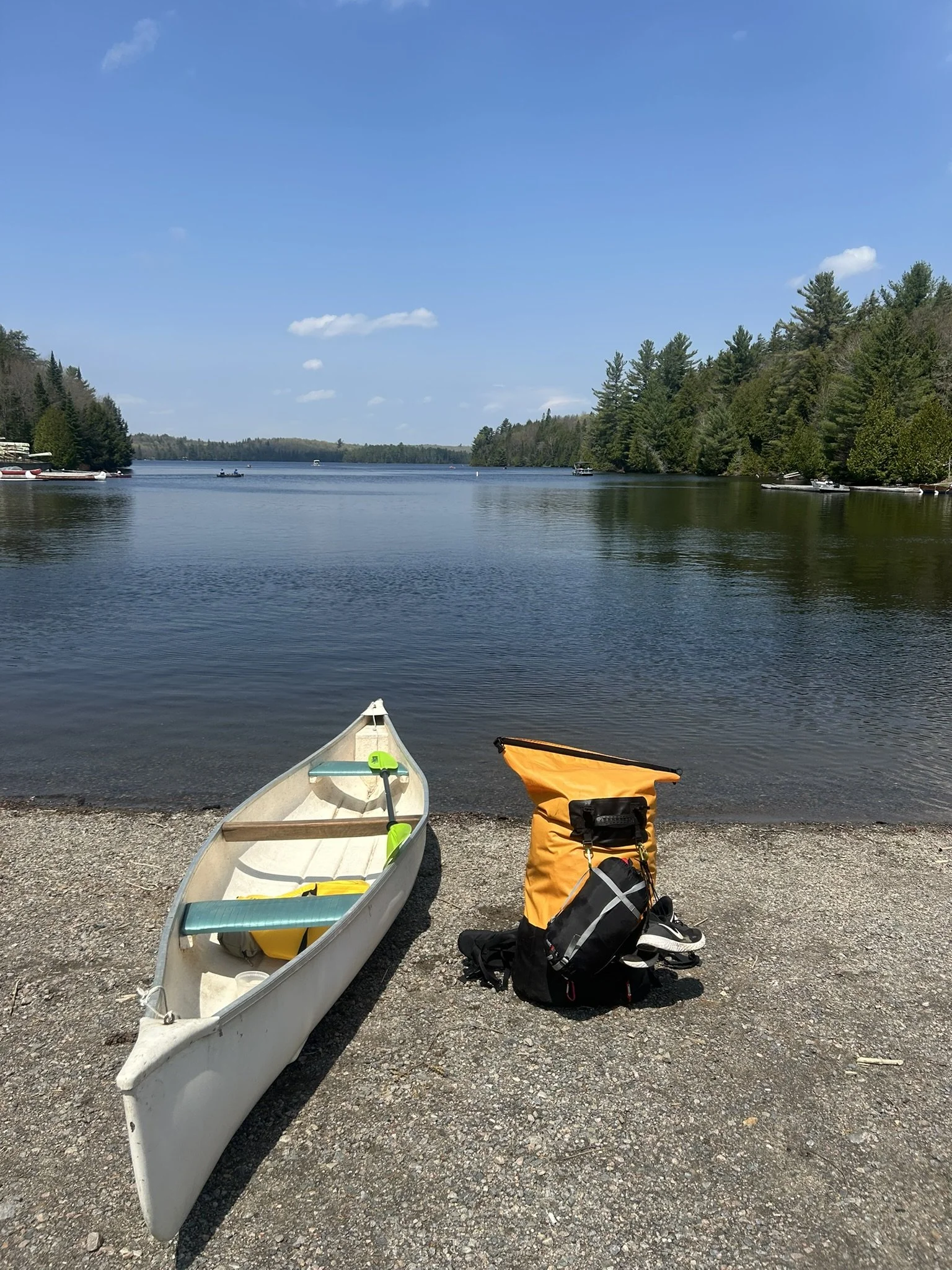
I woke up around 4:45 a.m. and took my time getting ready. Shower, coffee, last-minute gear checks, the usual routine. Eventually I got out the door around 7:30 and started the drive north. The drive itself was smooth. I stopped in Huntsville for a Subway wrap, listened to some camping music and an episode of Pardon My Take, and slowly settled into trip mode. As always, the closer I got to Algonquin, the more real the whole thing started to feel.
When I arrived at Canoe Lake, I noticed something familiar. Just like on my first solo trip, I kept finding reasons not to leave. I used the bathroom. Picked up my rental gear. Rearranged things in my packs. Opened compartments I had already organized three times. Every time I finished one task, I seemed to invent another. Looking back, I think a big part of it was nerves. What threw me off even more was the complete lack of cell service. In previous years, I could usually get enough reception at Canoe Lake to check the weather radar or make a quick phone call before heading into the park. This year was different. Rogers had apparently deactivated their towers along Highway 60 after Starlink took over service in the area. Since Fido runs on the Rogers network, I was completely out of luck.
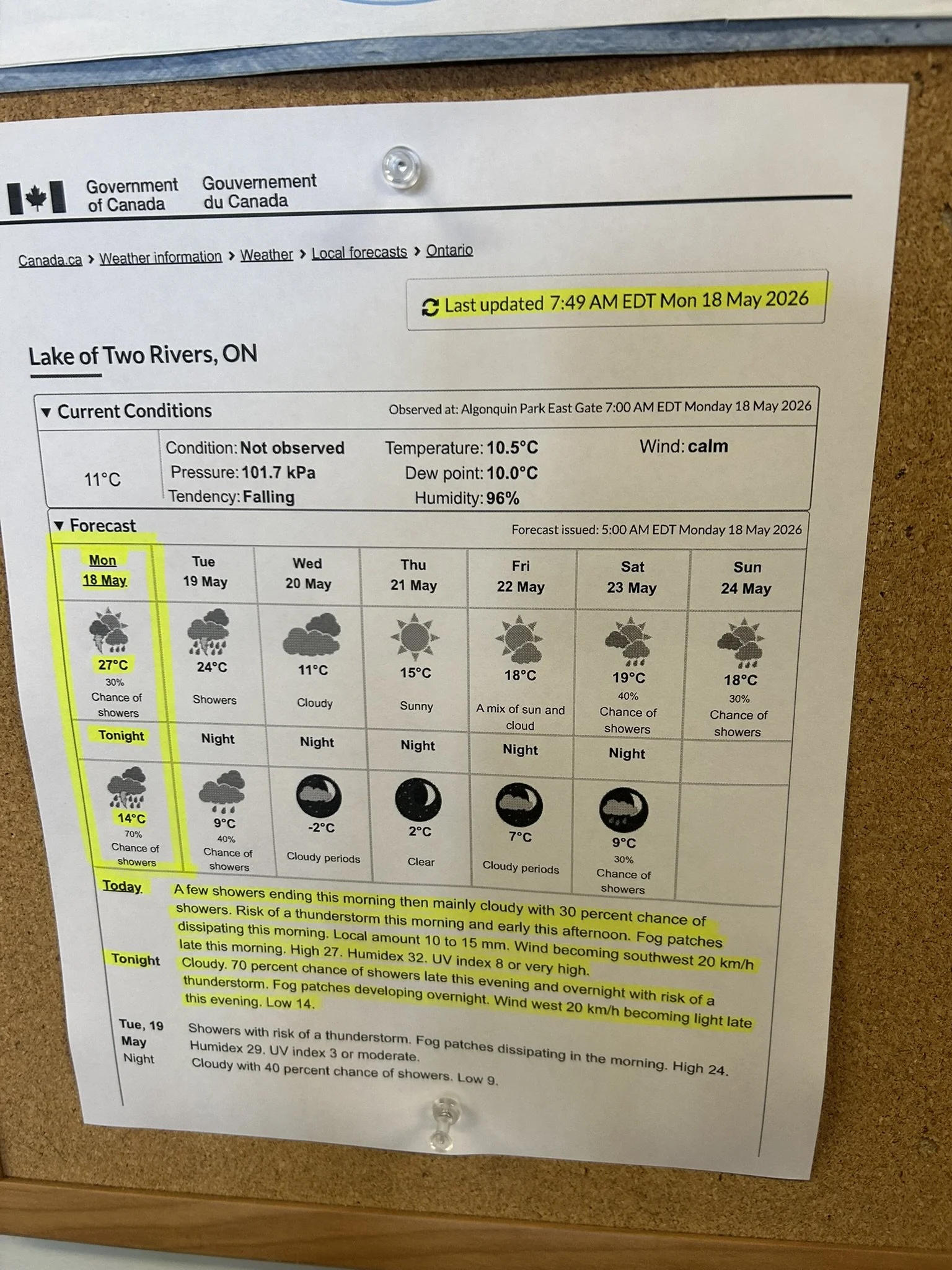
Under normal circumstances it probably would not have bothered me much, but thunderstorms were forecasted for that evening and I wanted one last look at the radar before disappearing into the backcountry. Thankfully, the staff at Algonquin Outfitters and the permit office were kind enough to let me use their phones. I called Nicole twice before launching. Even after those calls, though, I still found myself lingering around the car. There is always a moment on a solo trip when you realize that once you push off from shore, every decision becomes yours. No second opinions. No backup plans. Just you. Finally, around 12:45 p.m., I launched.
The paddle down Canoe Lake was beautiful. The wind was at my back, the sky was blue, and despite the forecast, the weather looked almost perfect. It was also unbelievably hot. Normally I keep my phone in my bug jacket pocket while tracking my route, but there were barely any bugs out at all. The bug jacket stayed packed away, and so did my phone. Looking back, I barely took any photos or videos during the first half of the day. I think when Nicole is with me, we naturally stop to appreciate things together. This time I just kept moving. About forty-five minutes later I reached the Joe Lake portage, often referred to as the "highway" because of how busy it can get. I passed plenty of people heading out of the park, but I was the only person I saw travelling deeper in. There is always something satisfying about that feeling. Every paddle stroke takes you farther away from roads, schedules, and obligations.
The first portage went smoothly enough, but it quickly reminded me that not having a proper yoke was going to be a problem. I could carry the canoe, but balancing it required constant effort. Every step felt less stable than it should have. It was manageable, just inefficient. Combined with the heat, it wore me down faster than expected. By this point I was starving. Earlier in the day I had been too nervous to eat much of my Subway wrap, but after the portage I absolutely demolished it. It may have been one of the best wraps I have ever eaten. Hunger has a way of improving even the most average meals.
From Joe Lake I continued through Little Joe and toward the creek system connecting into Lost Joe. One of the highlights of the day was bypassing both the 120-metre and 400-metre portages by travelling through the creek itself. Some sections were deep enough to paddle while others required getting out and walking the canoe upstream through the current. The water was freezing cold, but manageable with my Sealskinz socks on. Eventually I stopped caring. At one point I looked down, realized the water was already pouring over the tops of the socks, and decided, "You know what? Screw it." The creek was worth it. Hundreds of fish filled the waterway, including some surprisingly large ones. I am not much of a fisherman, but even I found myself staring into the water thinking that if I had brought a rod, this would have been the place to use it.
Eventually I made my way through Lost Joe, Baby Joe, and onward toward Burnt Island Lake. The portage into Burnt Island was the first carry that really humbled me. The trail itself was not especially difficult, but between the heat and the awkward canoe carry, I arrived absolutely drenched in sweat. The moment I reached the lake, there was only one thing on my mind. Swimming. I kept my shorts on and dove straight into the water. It was shockingly cold. The kind of cold that steals your breath for a second. After the heat of the portage, though, it felt incredible. I floated there for a few minutes, letting my body cool down and enjoying the feeling of finally being on Burnt Island Lake.
Originally, the plan had been to push all the way to Otterslide Lake that evening. As I floated there, I started doing the mental math. It was already after 4:00 p.m. Thunderstorms were expected later that night. Did I have enough time to make it safely? Maybe. Maybe not. I climbed out of the water, walked over to the canoe, grabbed the gunwales, and lifted. Crack. I immediately knew something was wrong. One side of the thwart had completely failed. Well, that happens.
The damage was not catastrophic, but it was significant. One screw had sheared off completely and the wood on the opposite side had rotted enough that it finally gave way. My first instinct was to immediately pull out the repair kit and start fixing it on the spot. Instead, I deliberately used one of the DBT skills I spend so much time teaching other people: STOP. Rather than rushing in and potentially making things worse, I forced myself to pause, sit down with water and a clif bar, take a breath, and then actually assess what had happened before touching anything.
Once I slowed down, I found myself using another skill: Size of the Problem. This was not a small problem. A broken thwart could absolutely affect every remaining portage on the trip. At the same time, it was not a large problem either. I was not injured. I was not lost. I did not need a rescue. The canoe was still functional. I landed somewhere in the middle. A medium-sized problem with potentially serious consequences if I handled it poorly.
Then I found myself thinking about Adam Shoalts.
One thing I've always admired about his wilderness travel philosophy is his ability to deliberately reframe adversity. When something goes wrong, he seems to immediately start looking for reasons why it might actually be a positive. Throughout the trip I kept coming back to the phrase, "No no, this is a good thing because..."
So I tried it.
No no, this is a good thing because the canoe didn't break halfway through a long portage. No no, this is a good thing because it didn't break days later on some remote stretch of the route. No no, this is a good thing because it happened on Day 1, close enough to people, campsites, and options.
Then another thought popped into my head.
No no, this is a good thing because I get to practice problem-solving without Google.
That's actually kind of cool.
Most problems in everyday life come with instant access to answers. You pull out your phone, search for a solution, watch a YouTube video, or ask someone who knows more than you. Out here, none of that existed. The canoe was broken, I had the tools I had, and the solution would have to come from observation, creativity, and trial and error. The situation still sucked, but almost immediately I felt my mindset shift from frustration toward curiosity and problem-solving.
Only then did I pull out the repair kit. Unfortunately, the screws used a square-head fitting and I did not have a square-head bit. I tried improvising with other tools, but only managed to partially strip the screw. That was the moment the trip changed. Before the thwart broke, I was deciding whether to push farther. After it broke, every future portage suddenly became a question mark.
I paddled over to the same campsite Nicole and I had stayed at during our very first trip together years earlier. Funny enough, it felt much smaller than I remembered. There was also a huge blowdown that had changed the look of the site considerably. I sat there for a while, ate part of a Clif Bar, drank some water, and considered my options. Realistically, pushing to Otterslide no longer felt like the smart choice. A damaged canoe and an incoming thunderstorm are not a great combination. In my head, I could practically hear Nicole saying, "Nope. Stay on this lake." She was right.
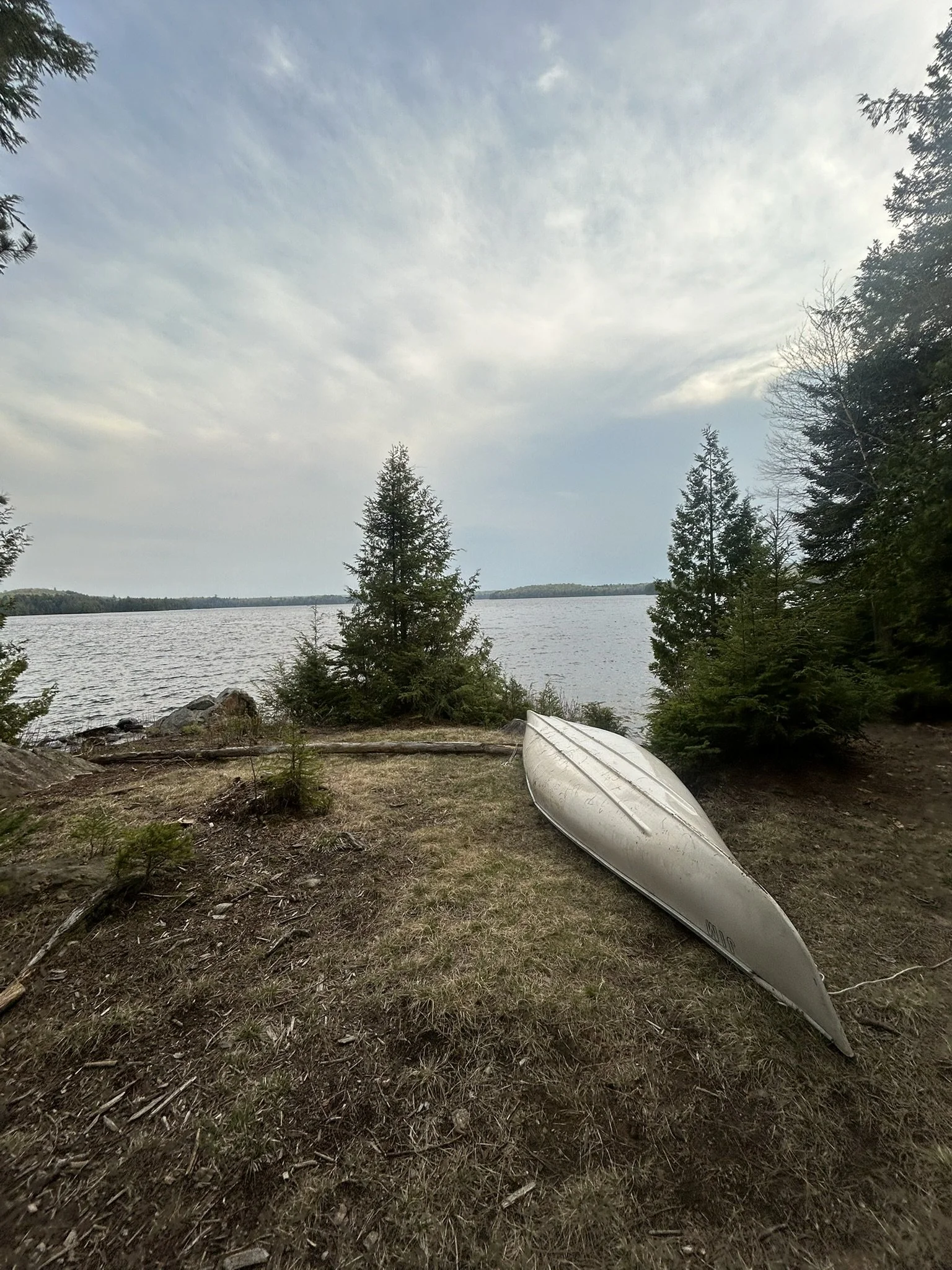
Instead, I decided to continue a little farther down Burnt Island to shorten the following day's travel. Along the way I stopped at Burnt Island Bistro, hoping the campers there might have a square-head screwdriver. No luck. The couple camping there were actually windbound themselves and had been unable to leave that day. They did offer a few suggestions, but ultimately I would have to figure out the repair on my own. Eventually I found a beautiful campsite near the eastern end of the lake and decided that would be home for the night. Good thing, too.
Around 9:00 p.m., the storm arrived. I had just gotten a fire going and placed my first hot dog over the flames when I noticed the clouds building across the lake. At first I thought I had time. Then I watched the dark wall of weather move toward me and realized I definitely did not. Suddenly dinner became a race. Every few seconds I would glance at the hot dog, then back at the approaching clouds. The clouds won. I scarfed down the hot dog, threw everything important into dry bags, and dove into the tent just as the storm hit.
Then the sky exploded. Thunder cracked overhead. Lightning flashed nonstop. Rain hammered the tent so hard that conversation would have been impossible. I sat on top of my sleeping pad wearing my running shoes because the rubber soles somehow made me feel safer. I said the Lord's Prayer. Thought about Nicole. Tried to stay calm. At one point I even did an imagination vacation exercise. Normally my imagination vacation involves picturing myself camping. This time I imagined being back home in my condo.
Eventually the thunder began moving farther away. The rain eased off about half an hour later. Once things finally settled down, I realized I was still hungry. Very hungry. So I climbed out of the tent, boiled water, cooked more hot dogs, heated up the broccoli Nicole had packed for me, and finally ate a proper meal. It ended up being one of those strangely satisfying camp dinners that only happen after a difficult day. Nothing fancy. Just hot food, dry clothes, and the realization that everything had worked out.
The canoe was still broken. The repair had not been tested. Somewhere beyond Burnt Island were thirteen portages and more than a hundred kilometres still to travel. That was tomorrow's problem. For now, I was warm, fed, dry, and exactly where I wanted to be. Coffee. Oatmeal. Fix the canoe. Then onward to Big Trout.
Trip at a Glance
Trip Length: 8 Days / 7 Nights
Solo Trip #: 3
Backcountry Trip #: 8
Planned Route:
Canoe Lake → Otterslide Lake → Big Trout Lake → Burntroot Lake (3 nights) → Big Trout Lake → Burnt Island Lake → Canoe Lake/Home
Actual Route:
Canoe Lake → Burnt Island Lake → Big Trout Lake → Burntroot Lake (3 nights) → Big Trout Lake → Little Otterslide Lake → Canoe Lake/Home
Paddling Distance: 88.8 km
Portaging Distance: 27.6 km
Total Distance Travelled: 116.4 km
Total Portages: 26
New Lakes Travelled: 6
New Creek Travelled: 1
Favourite Campsite: Anchor Island, Burntroot Lake